Image · ESO / VISTA / J. Emerson · The Helix Nebula (NGC 7293)
Science

Three connected
science goals.
One physical story.

Galaxies are not isolated collections of stars. They are evolving ecosystems, continuously exchanging matter and energy among stars, black holes, interstellar gas, and the enormous reservoirs surrounding them.

The processes that control this exchange occur across a vast range of scales—from the environments immediately surrounding growing black holes, through individual star-forming regions, and outward into galaxy halos. No existing observatory can connect all of these scales with the spatial resolution, wavelength coverage, sky access, and observing cadence needed to follow the complete cycle.

CELESTE pairs a space-borne laser guide star with the collecting power of the world's largest ground-based telescopes. By extending high-performance adaptive optics to targets that cannot be reached with conventional natural guide stars, CELESTE enables milliarcsecond-scale imaging and spatially resolved spectroscopy across a dramatically expanded fraction of the sky.

Together with JWST, Roman, Rubin, Hubble, and existing multiwavelength surveys, CELESTE will reveal how galaxies acquire their fuel, convert it into stars and black holes, and return matter and energy to their surroundings.

The Science Story

Following matter through the galaxy ecosystem.

CELESTE's science program is organized around three linked questions.

01

How did the first mature galaxies emerge so quickly?

02

How do growing black holes influence their host galaxies?

03

How do galaxies acquire, retain, eject, and recycle the material required for growth?

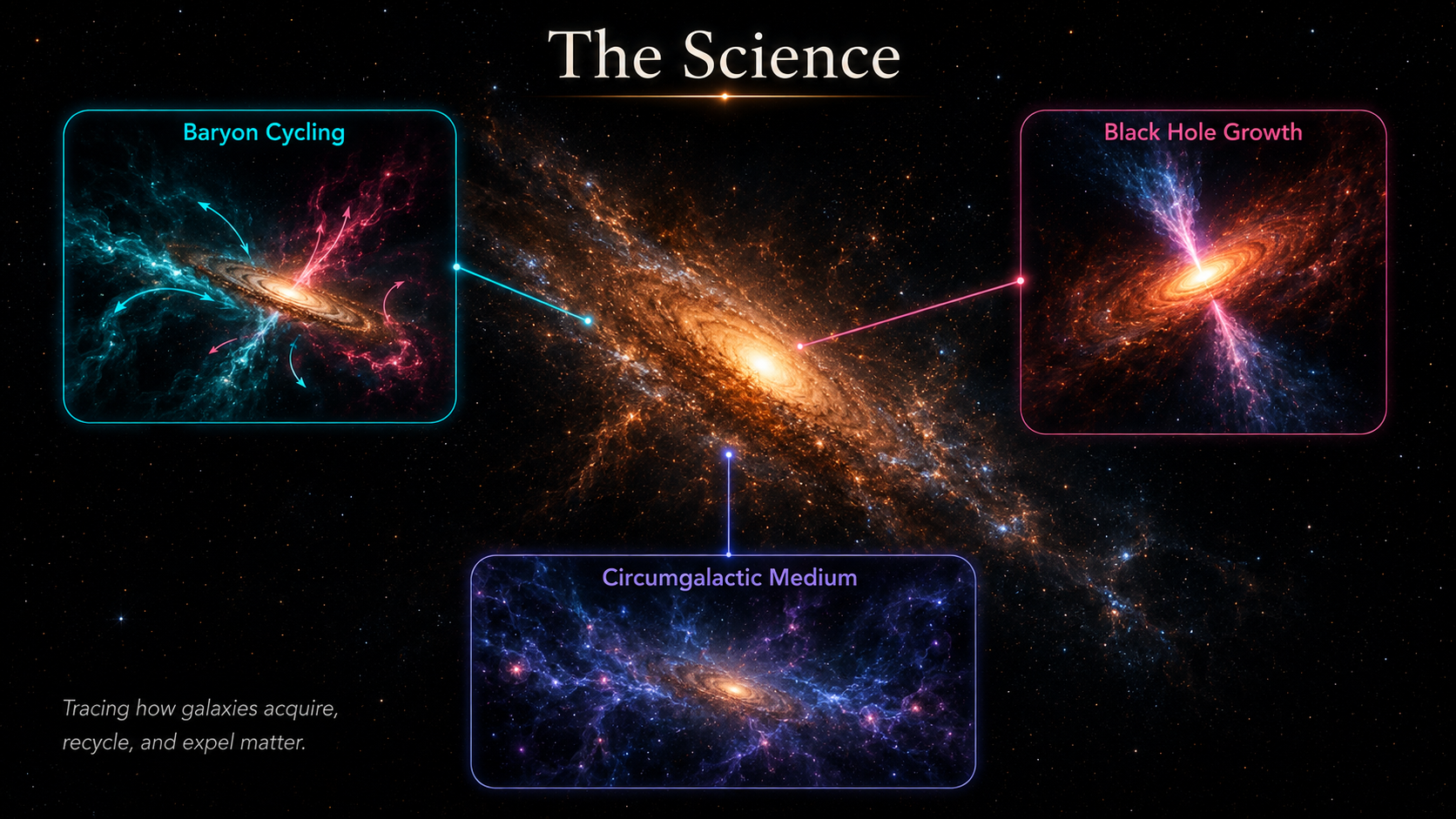
These are not separate science cases. They describe successive parts of the same cycle. Gas enters galaxies from their surroundings, forms stars and feeds black holes, and is then redistributed by stellar and black-hole feedback. CELESTE will trace that cycle across cosmic time and from tens of parsecs to the scales of galaxy halos.

The CELESTE science story — baryon cycling, black hole growth, and the circumgalactic medium, illustrated around a spiral galaxy
One cycle, three connected views — baryon cycling, black hole growth, and the circumgalactic medium.
ESO
— Science Goal 1

Cosmic Morning.

How did the first mature galaxies emerge so quickly?

JWST is revealing a young universe filled with unexpectedly luminous, compact, and apparently mature galaxies. These discoveries include rapidly assembling disks, compact massive systems, strong emission-line galaxies, and enigmatic red sources frequently described as Little Red Dots.

Their integrated light tells us that something remarkable is happening. It does not yet reveal the underlying physical structures.

CELESTE will resolve the internal architecture of galaxies during the first few billion years of cosmic history. High-resolution imaging and spectroscopy with partner observatories will distinguish compact nuclei from stellar hosts, ordered disks from mergers, and individual star-forming regions from unresolved galaxy-wide emission.

Gravitationally lensed systems will extend these measurements to even smaller physical scales, allowing CELESTE to study structures that would otherwise remain beyond the reach of any planned facility.

CELESTE will
  • Determine whether early galaxies are dominated by disks, mergers, compact stellar systems, or growing black holes.
  • Resolve star-forming regions, compact nuclei, and structural components that are blended in current observations.
  • Map the distribution, ionization, motion, and chemical enrichment of gas within young galaxies.
  • Measure how rapidly galaxies build their stellar mass and central black holes.
  • Use gravitational lensing to probe the smallest structures accessible in the early universe.
  • Connect detailed CELESTE observations to the larger galaxy populations discovered by JWST and Roman.
The Result

CELESTE will transform the first mature galaxies from unresolved sources into physical systems whose formation histories, internal structures, and growth mechanisms can be directly tested.

Explore Cosmic Morning
ESO
— Science Goal 2

Black Hole Growth.

How do growing black holes reshape their galaxies?

Supermassive black holes can release enormous amounts of energy as they accrete matter. That energy can heat, accelerate, compress, or remove the gas from which future stars would otherwise form.

Black-hole feedback is therefore central to nearly every modern theory of galaxy evolution. Yet observations rarely connect the compact regions where accretion varies to the larger structures through which winds propagate and the galaxy halos where their energy is ultimately deposited.

CELESTE will resolve the interaction between growing black holes and their host galaxies across this full range of scales.

Spatially resolved observations will map the geometry and kinematics of ionized gas, distinguish black-hole-driven winds from stellar feedback, and determine whether outflows escape, stall, or return to the galaxy. Rapid and repeatable observations will also measure short-timescale variability, connecting changes in black-hole accretion to the evolving response of the surrounding gas.

CELESTE will
  • Resolve the structure of active galactic nuclei and their immediate host environments.
  • Map the geometry, velocity, ionization state, and energetics of black-hole-driven winds.
  • Follow feedback from nuclear regions through the interstellar medium and toward the circumgalactic halo.
  • Separate the effects of black-hole activity from winds produced by massive stars and supernovae.
  • Determine where feedback deposits its mass, metals, momentum, and energy.
  • Use rapid-cadence observations to study accretion variability and reverberation.
  • Test when black holes suppress star formation, trigger it, or redistribute the available gas.
The Result

CELESTE will connect the variable central engine of an active galaxy to the galaxy-wide and halo-scale consequences of its energy output.

Explore Black Hole Growth
ESO
— Science Goal 3

Cosmic Ecosystems.

How do galaxies acquire, retain, and recycle matter?

Galaxies grow by drawing gas from their surroundings. Stars and black holes then return matter, metals, and energy to the interstellar medium and circumgalactic halo. Some of that material escapes. Some remains suspended in the halo. Some cools and returns to fuel another generation of star formation.

This baryon cycle connects the smallest structures within galaxies to the cosmic web.

Current observations usually isolate only one part of the cycle. CELESTE will connect the star-forming disk, the sources of feedback, and the surrounding gas reservoir within a common spatially resolved framework.

Observations of dwarf galaxies, massive galaxies, active galaxies, and their environments will establish how the baryon cycle changes with galaxy mass, evolutionary stage, and environment. Nearby resolved stellar populations will provide an archaeological record of how these processes operated over time.

CELESTE will
  • Map inflowing, outflowing, and recycling gas within and around galaxies.
  • Connect individual sites of star formation and feedback to galaxy-scale gas transport.
  • Measure how mass, metals, momentum, and energy move between galaxies and their halos.
  • Determine which galaxies retain their baryons and which lose them.
  • Compare baryon cycling in dwarf galaxies, massive galaxies, and active-galaxy hosts.
  • Resolve stellar populations in nearby galaxies to reconstruct their histories of star formation and chemical enrichment.
  • Test galaxy-formation simulations using spatially resolved measurements rather than integrated averages.
The Result

CELESTE will establish how galaxies obtain the material required for growth, how feedback redistributes that material, and how much ultimately returns to form new stars and black holes.
A Connected Observatory

From tens of parsecs to galaxy halos.

The defining strength of CELESTE is not a single measurement. It is the ability to connect physical processes that are normally studied separately.

Lensing.

Gravitational lenses magnify distant galaxies and make their smallest structures accessible. CELESTE will use lensing fields as natural telescopes for studying early galaxies, compact sources, star-forming regions, and black-hole hosts.

Emission.

Spatially resolved emission reveals where stars form, where gas is ionized, how it is chemically enriched, and whether it is moving into or out of a galaxy.

Spatially resolved transport.

CELESTE will measure how gas, metals, momentum, and energy move through galaxies and into their surroundings. These observations turn static images into a physical account of galaxy growth and regulation.

Together, these capabilities give CELESTE its name
CCosmic
EEcosystems
LLensing
EEmission
SSpatially-resolved
TTransport
EExplorer
Why CELESTE

The missing link between space surveys and giant telescopes.

JWST is discovering new populations of distant galaxies and black holes. Roman and Rubin will identify enormous samples across wide areas of sky. The Extremely Large Telescope and other next-generation observatories will provide unprecedented collecting area and spectroscopic power.

CELESTE connects these facilities.

Its space-borne laser guide star expands access to high-quality adaptive-optics correction beyond fields containing suitably bright natural guide stars. Partner ground observatories then provide the collecting area and science instrumentation needed to resolve faint structures and measure their spectra.

ESO
This hybrid architecture enables
  • 01
    High spatial resolution
    Resolve structures hidden within the integrated light of galaxies.
  • 02
    Expanded sky access
    Reach scientifically important targets selected for their physics rather than their proximity to a natural guide star.
  • 03
    Imaging and spatially resolved spectroscopy
    Connect morphology to motion, ionization, chemical enrichment, and feedback.
  • 04
    Rapid and repeated observations
    Measure variability, evolving structures, and transient events on their natural timescales.
  • 05
    Multi-observatory synthesis
    Combine CELESTE-enabled observations with the depth of JWST, the survey reach of Roman and Rubin, and the multiwavelength legacy of Hubble and other observatories.
Observing Strategy

Built on the deepest views of the universe.

The CELESTE proposal includes a reference observing program centered on fields and targets with extensive existing or planned observations.

Potential high-value fields include:

COSMOS CEERS / EGS JADES / GOODS-N JADES / GOODS-S PRIMER UNCOVER / Abell 2744 GLASS

— and other gravitational-lensing and legacy-survey fields.

These regions already contain deep imaging, spectroscopy, lens models, and large target catalogs. CELESTE will add the spatial resolution and resolved physical diagnostics needed to interpret those datasets.

The reference program also includes nearby benchmark galaxies, dwarf galaxies, active-galaxy hosts, and circumgalactic environments. Together, these targets connect detailed local measurements to the unresolved populations seen across cosmic time.

Final target selection and observing responsibilities will be coordinated with participating observatories and instrument teams. The proposal's reference program demonstrates scientific feasibility and mission value while preserving flexibility for discoveries made before launch.

Beyond the Three Goals

A platform for discovery.

The same capabilities required for CELESTE's core galaxy science will support a broader astrophysical program.

Potential investigations include
  • Resolved stellar populations and the assembly histories of nearby galaxies.
  • Time-domain observations of active nuclei and rapidly evolving transients.
  • Strong and weak gravitational-lensing studies.
  • Precision astrometry and photometric calibration.
  • Resolved observations of Solar System bodies and changing planetary atmospheres.
  • Studies of compact objects, star clusters, and crowded stellar environments.
  • Community-selected targets of opportunity and archival investigations.
ESO
Scope

These programs are enabled by the mission architecture, but they do not replace the three science goals that drive CELESTE's design.

Decadal Priority

Delivering the spatially resolved view of Cosmic Ecosystems.

The 2020 Astrophysics Decadal Survey identified understanding the drivers of galaxy growth as a central objective for the coming decades.

ESO / G. Vecchia

CELESTE directly addresses that objective by measuring how galaxies acquire gas, form stars and black holes, launch feedback, and exchange material with their surroundings.

Rather than studying isolated pieces of this process, CELESTE will connect them:

  • the first galaxies to their internal structures;
  • growing black holes to their host galaxies;
  • and star formation and feedback to the circumgalactic reservoirs that regulate future growth.

CELESTE will provide the spatially resolved observations needed to turn the Cosmic Ecosystems framework into a quantitative account of galaxy evolution.

One Mission

The complete cycle of galaxy growth.

ESO / S. Brunier
Matter enters galaxies.
It forms stars and feeds black holes.
Feedback redistributes it.
Some escapes. Some returns.
Galaxies begin the cycle again.

CELESTE will observe that cycle across cosmic time—from the first mature galaxies to the nearby systems in which individual stars, winds, and gas flows can be resolved.

Read the Mission Concept Explore the Technology Meet the Science Team